
According to statistics released by the World Health Organization (WHO) in recent years, approximately one million people worldwide die each year from mosquito or pest bites. Studies have found that a single mosquito can carry at least 300 different pathogens, transmitting more than 80 diseases to humans through its bites, including dengue fever, malaria, yellow fever, filariasis, and encephalitis. When a person is bitten by a virus-carrying mosquito, they may indirectly contract a disease. Areas with poor sanitation are the hardest hit when it comes to deaths caused by diseases from mosquito bites.
The incidence of dengue fever has increased dramatically globally in recent decades, putting approximately half of the world's population at risk. An estimated 500,000 severe dengue fever cases require hospitalization each year, with an estimated 2.5% mortality rate annually. The situation is equally dire for mosquito-borne malaria. The World Malaria Report, released in December 2019, indicated an estimated 228 million cases of malaria globally in 2018, resulting in 405,000 deaths.
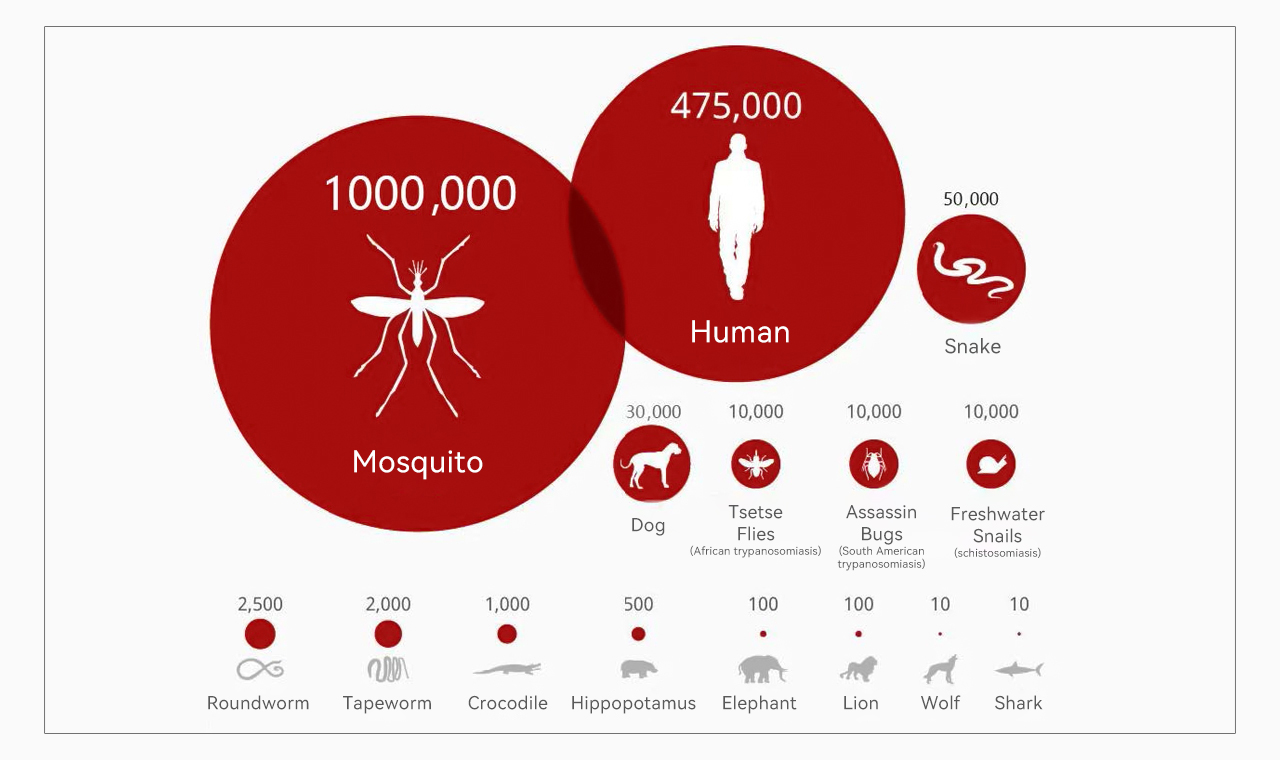
According to Gatesnotes, some of the world's deadliest animals are not creatures typically considered terrifying, such as lions or snakes. In terms of annual human deaths, mosquitoes are by far the deadliest organism in the world, causing approximately one million deaths annually, making them the undisputed number one killer. Snakes cause about 100,000 deaths each year. Perhaps surprisingly, dogs are the third deadliest animal to humans, causing approximately 30,000 deaths annually, the vast majority of which are due to rabies transmitted by dogs.