
A fluorescent lamp mainly consists of a fluorescent tube, a circuit, and electrodes. The fluorescent tube is evacuated and filled with inert gases (such as argon or mercury vapor). There are electrodes at both ends. When current is passed through the electrodes into the fluorescent tube, the gas inside the tube is excited and produces ultraviolet light. Phosphor powder is coated on the inner wall of the fluorescent tube, which can absorb ultraviolet light and convert it into visible light.
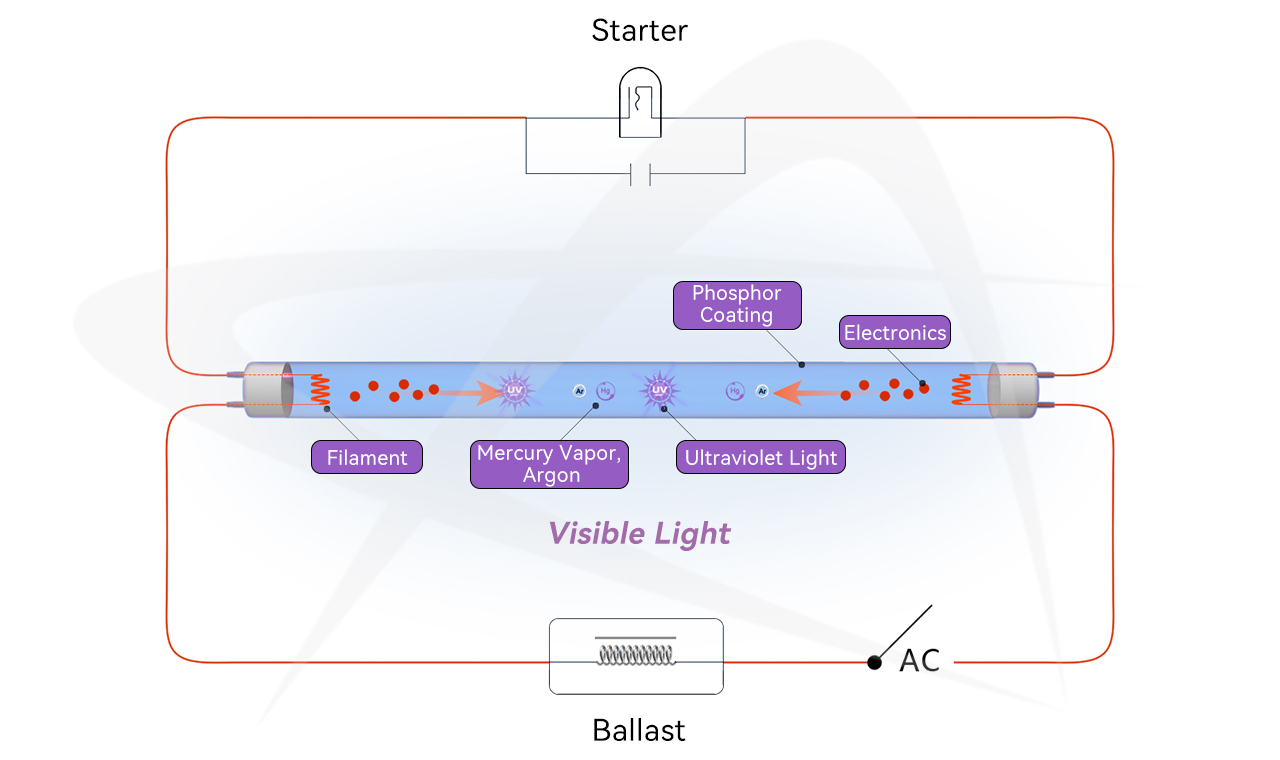
As shown in the diagram, a fluorescent lamp consists of a tube, a ballast, a starter, and a switch. The tube is filled with inert gases such as mercury vapor and argon, and the inner wall of the tube is coated with a fluorescent material. From the circuit diagram, we can see that the switch, filament, ballast, and starter are connected in series. The starter contains a glass bulb filled with neon gas and has stationary and moving metal contacts. When power is first applied, since the fluorescent lamp is not lit, the power supply voltage is temporarily applied between the pins of the starter, causing the neon gas to discharge and emit a glow. The glow generates heat, causing the moving contact to open and contact the stationary contact. At this time, the lamp filament, ballast, and starter form a closed circuit. The filament heats up and emits electrons, and the mercury near the filament begins to ionize and gradually vaporize. When the moving and stationary contacts of the starter are connected, the voltage across the starter is essentially zero, insufficient to sustain the neon gas discharge and glow. The starter temperature decreases, the metal plate of the moving contact cools and resets, and the contact opens. When the current in the circuit is suddenly interrupted, an induced voltage much larger than the power supply voltage is generated across the ballast coil. This voltage, combined with the power supply voltage, is applied across the lamp tube, causing the inert gas and mercury vapor inside the tube to ionize and produce an arc discharge, thus turning on the lamp. As the temperature inside the tube rises, the mercury vapor ionizes and violently collides with the inert gas molecules, discharging and radiating ultraviolet light. This excites the fluorescent material on the inner wall of the lamp tube, causing it to emit visible light. Besides providing high voltage during lamp startup, the ballast also functions to reduce voltage and limit current during normal operation. This is the working principle of a fluorescent lamp.
Ultraviolet (UV) radiation is the collective term for radiation in the solar spectrum with wavelengths ranging from 10 nm to 400 nm. It is invisible to the human eye and has a higher frequency than blue-violet light. Ultraviolet radiation is generally divided into three categories: UVA, UVB, and UVC.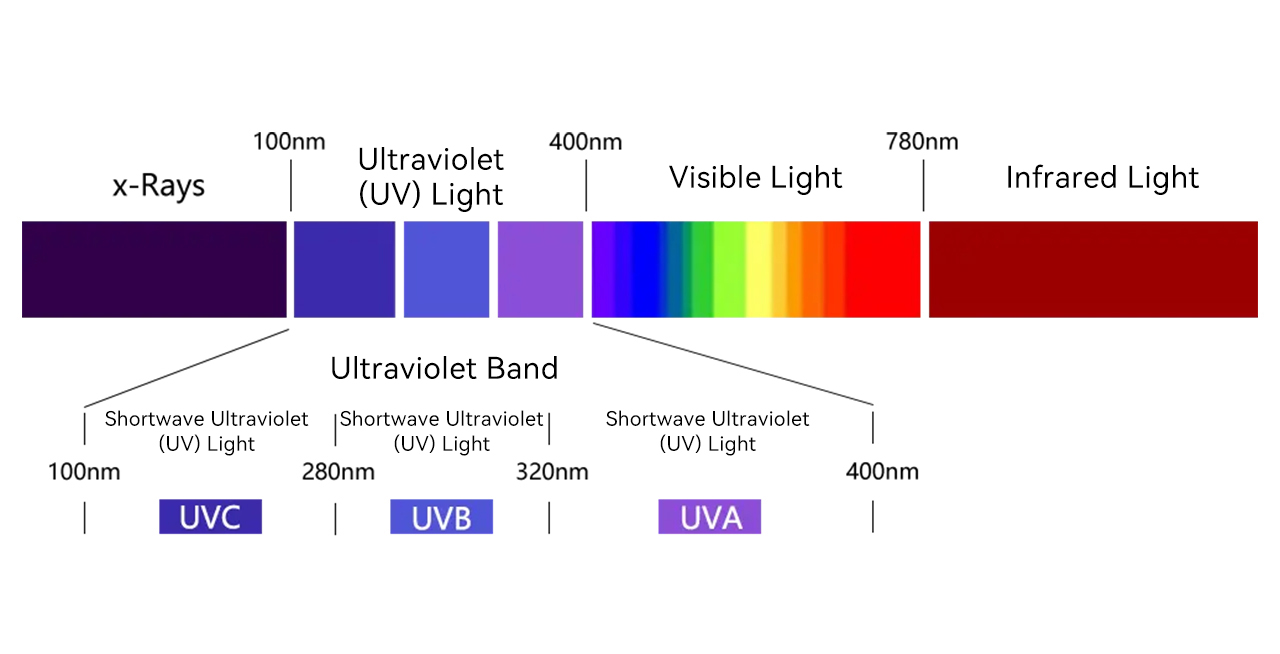
Mosquito-attracting fluorescent lamps typically have wavelengths between 365-395nm, falling within the UVA band. This wavelength range perfectly matches the phototactic response curve of mosquitoes, making it suitable for use in insect-attracting lamps. UV mosquito-attracting lamps are best used at night. It is recommended to place them in areas such as living rooms, balconies, kitchens, and bathrooms. People should leave the room while using them, and other light sources should be turned off. Avoid placing it in bedrooms where people are resting, as people attract mosquitoes more than mosquito-attracting lamps. In this way, it not only improves mosquito-killing efficiency but also avoids light pollution that could disrupt people's rest.